
Peer Review - ISO 7250-1:2017: Basic Human Body Measurements for Technological Design
https://medium.com/@jolalf

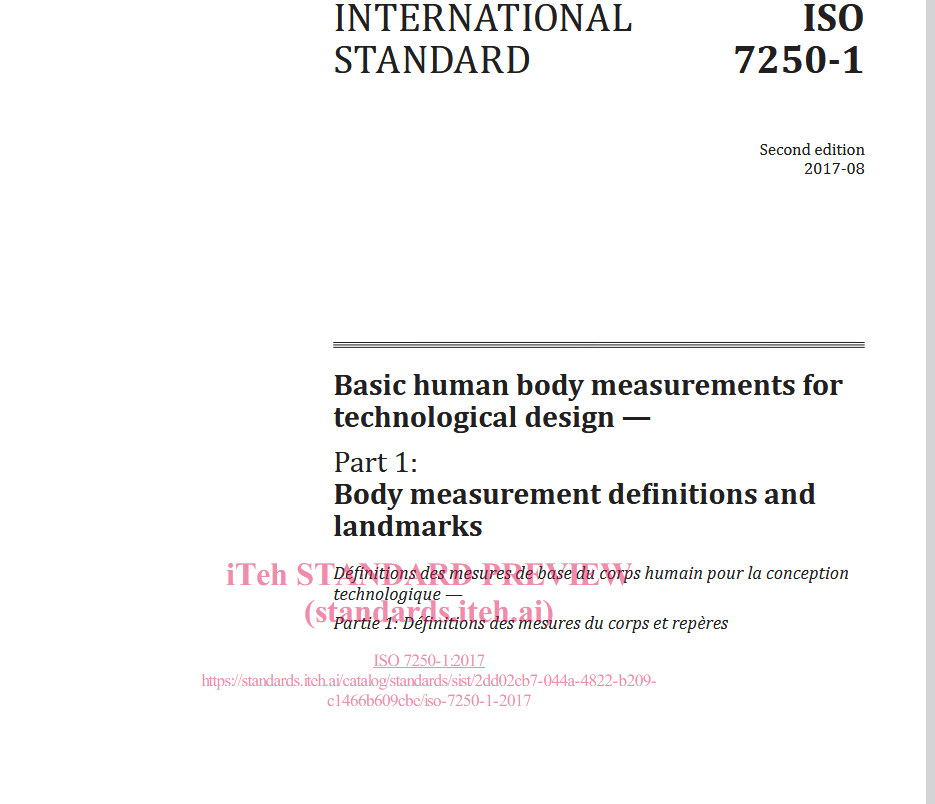

This is a detailed explanation of ISO 7250-1:2017, a foundational international standard for measuring the human body for technological design.
---
### An In-Depth Explanation of ISO 7250-1:2017: Basic Human Body Measurements for Technological Design
**Introduction: The Blueprint for Human-Centered Design**
Imagine a world where every car seat caused back pain, every kitchen counter led to a stooped posture, and every smartphone was impossible to hold comfortably. This is the world that ergonomics and anthropometry—the science of measuring the human body—seek to avoid. At the heart of this scientific approach lies a critical document: **ISO 7250-1:2017, “Basic human body measurements for technological design — Part 1: Body measurement definitions and landmarks.”**
This International Standard is essentially a universal dictionary and procedural guide for taking measurements of the human body. Published by the International Organization for Standardization (ISO) in 2017, it represents the second edition of a standard first released in 2008. Its primary purpose is to ensure that when an ergonomist in Japan, a designer in Germany, and a manufacturer in Brazil talk about “shoulder height,” they are all measuring the exact same thing in the exact same way. This consistency is the bedrock upon which safe, comfortable, and inclusive products, workplaces, and environments are built.
This document serves multiple critical functions:
1. **A Basis for Comparison:** It allows anthropometric data from different populations (e.g., German adults, Japanese children, Thai industrial workers) to be compared meaningfully.
2. **A Guide for Database Creation:** It provides the standard list of measurements for creating comprehensive anthropometric databases (as outlined in ISO 15535).
3. **A Foundation for 3D Scanning:** It defines the landmarks and measurements that can be extracted from 3D body scans (as specified in ISO 20685).
4. **A Practical Manual:** It gives designers and ergonomists the anatomical and metrological knowledge required to solve real-world design problems.
In essence, ISO 7250-1 is the foundation of human-centric design, translating the complex, variable reality of the human form into a structured, repeatable, and objective set of data points.
---
### Part 1: The Framework (Scope, Conditions, and Instruments)
The standard is meticulously structured to ensure scientific rigor and repeatability. It begins by establishing the rules of the game before a single measurement is taken.
#### 1. Scope (Clause 1)
The scope clearly defines the standard’s purpose: to describe anthropometric measurements that serve as a basis for comparing population groups and creating databases. It is explicitly intended for ergonomists and designers. It also clarifies its role as a guide for extracting measurements from 3D scans, acknowledging the technological evolution in anthropometry. The standard is meant to be used in conjunction with national or international regulations, ensuring global harmony in defining and comparing human body data.
#### 2. Conditions and Instruments (Clause 4)
This clause is crucial for eliminating variability. It establishes strict protocols to ensure that a measurement reflects the person’s anatomy, not the conditions of the measurement.
- **Clothing:** The subject must be nude or in minimal clothing, bareheaded, and without shoes. This eliminates the variability caused by different clothing thicknesses, heel heights, or hairstyles, ensuring the measurement is of the body itself.
- **Support Surfaces:** All surfaces (floors, seats, platforms) must be flat, horizontal, and non-compressible. This ensures a stable and consistent reference point for measurements like stature or sitting height.
- **Body Symmetry:** For measurements that could be taken on either side (e.g., hand length), it is recommended to measure both. If not, the side must be noted, as the human body is not perfectly symmetrical.
- **Body Posture:** This is one of the most critical sections.
- **Standing Posture:** The subject stands with heels together, looks straight ahead (maintaining the Frankfurt plane, a key head orientation reference), and breathes normally. This standardized posture ensures that measurements like stature are taken in a repeatable, non-arbitrary way.
- **Sitting Posture:** The subject sits erect with shoulders relaxed, looks straight ahead, and has their feet supported so that their thighs are horizontal. This posture is fundamental for measurements related to seated work, such as in vehicles or office chairs.
- **Instruments:** The standard specifies the approved tools of the trade:
- **Anthropometer:** A specialized, rod-like instrument for measuring vertical distances (e.g., height from the floor to a point on the body).
- **Sliding and Spreading Calipers:** For measuring breadths (e.g., hip breadth) and depths (e.g., chest depth).
- **Tape Measure:** For measuring circumferences (e.g., waist, chest).
- **Measuring Cube & Rod:** Simple tools used for specific functional measurements, like determining the maximum back protrusion of a seated person or the grip axis for hand measurements.
---
### Part 2: The Language of the Body (Landmarks, Clause 5)
Before any measurement can be taken, the specific points on the body from which to measure must be defined. These are the **landmarks**. Clause 5 provides a detailed, illustrated glossary of 22 key anatomical landmarks. This section is the vocabulary of anthropometry, ensuring that terms like “acromion” or “cervicale” have a precise, unambiguous meaning.
Key examples of these landmarks include:
- **Acromion (5.2):** The most lateral point on the edge of the shoulder blade (scapula). This is the bony point you can feel at the very top of your shoulder. It is a critical landmark for all shoulder-related measurements.
- **Cervicale (5.3):** The prominent bony tip at the base of the back of the neck (the spinous process of the 7th cervical vertebra). This is a key reference for the start of the back and for measuring spinal posture.
- **Glabella (5.6):** The most anterior (forward) point of the forehead between the eyebrows. This landmark, along with others, helps define the orientation of the head.
- **Tragion (5.20):** The cartilaginous notch just in front of the ear canal. This is a crucial landmark for defining the **Frankfurt Plane**, a standard horizontal head orientation plane used in many measurements to ensure the head is not tilted.
- **Vertex (5.22):** The highest point on the top of the head. This is the primary landmark for the measurement of stature (body height).
By defining these points, the standard creates a universal, anatomical language. When a designer reads “shoulder height,” they know it is measured from the floor to the *acromion*, not just “where the shoulder seems to be.”
---
### Part 3: The Measurements (Clause 6)
This is the heart of the standard, listing over 60 distinct anthropometric measurements. They are logically grouped into four categories based on posture or the body segment being measured: standing, sitting, specific body segments (like hands and head), and functional measurements.
#### 6.1 Measurements Taken While the Subject Stands (Static Standing Dimensions)
These are the fundamental measurements of the upright human form. They are essential for designing spaces where people stand, such as doorways, workbenches, or public transportation.
- **Stature (6.1.2):** The classic “body height,” measured vertically from the standing surface to the *vertex*.
- **Eye Height (6.1.3):** Critical for designing sightlines in vehicles, control rooms, and for placing visual displays like monitors or signs.
- **Shoulder Height (6.1.4):** Measured from the floor to the *acromion*. This is key for determining the height of work surfaces.
- **Chest Depth (6.1.9) & Chest Breadth (6.1.11):** These measurements are fundamental for designing clearance in corridors, aisles, and the interior space of clothing and personal protective equipment.
- **Hip Breadth (6.1.12):** A critical measurement for seating width, especially in chairs, theaters, and vehicles.
#### 6.2 Measurements Taken While the Subject Sits (Static Sitting Dimensions)
This section is arguably the most important for the design of workstations, vehicles, and furniture. The standardized sitting posture (thighs horizontal) is critical.
- **Sitting Height (6.2.1):** The vertical distance from the sitting surface to the *vertex*. This determines head clearance in vehicles, cockpits, and other enclosed workspaces.
- **Eye Height, Sitting (6.2.2):** Essential for positioning dashboards, windscreens, and monitors relative to a seated user.
- **Popliteal Height (6.2.11):** The height from the floor to the back of the knee (the *popliteal* area). This is the primary measurement for determining optimal seat height.
- **Buttock-Popliteal Length (6.4.7):** The horizontal distance from the back of the buttock to the back of the knee. This defines the required seat depth to support the thigh without pressing into the back of the knee.
- **Hip Breadth, Sitting (6.2.10):** The maximum horizontal breadth of the seated body. This is a key dimension for seat width, especially in public seating like airplanes or stadiums.
- **Abdominal Depth, Sitting (6.2.14) & Buttock-Abdomen Depth (6.2.16):** These measurements, which account for the forward protrusion of the abdomen, are crucial for ensuring adequate clearance between the occupant and the steering wheel, desk, or other controls.
#### 6.3 Measurements on Specific Body Segments (Hand, Foot, Head)
These highly detailed measurements are used for designing products that interact with specific parts of the body.
- **Hand Length (6.3.1), Palm Length (6.3.2), Hand Breadth (6.3.3):** These are fundamental for designing the size and shape of handles, grips, tools, keyboards, and even the width of a smartphone.
- **Index Finger Length & Breadth (6.3.4-6.3.6):** These highly specific dimensions are used for designing precise controls, like buttons on a control panel, keypads, and triggers.
- **Foot Length & Breadth (6.3.7-6.3.8):** Essential for the shoe industry, but also for designing pedal placement in vehicles, safety footwear, and the clearance under work surfaces.
- **Head Length & Breadth (6.3.9-6.3.10), Head Circumference (6.3.12):** These are critical for designing helmets, headgear, and protective equipment, ensuring a proper and safe fit.
#### 6.4 Functional Measurements (Dynamic & Reach)
This section moves beyond static postures to capture measurements that involve movement or interaction with the environment. These are often the most critical for usability.
- **Grip Reach; Forward Reach (6.4.2):** The maximum distance a person can reach forward from the back of their shoulder. This defines the boundaries of a comfortable and safe reach envelope in a workplace or vehicle cockpit.
- **Elbow-Grip Length (6.4.4):** The distance from the elbow to the gripping axis of the hand. This is vital for designing control levers and the placement of joysticks.
- **Buttock-Knee Length (6.4.8):** The horizontal distance from the back of the buttock to the front of the knee. This is the key dimension for determining the legroom required behind a seated person.
- **Chest Circumference (6.4.10), Waist Circumference (6.4.11), Thigh Circumference (6.4.13):** These circumferential measurements are not just for clothing. They are used for designing personal flotation devices, safety harnesses, and for ensuring that seats and armrests do not create pressure points.
---
### Part 4: The Importance and Application of the Standard
#### The “Why” Behind the Numbers
The rigor of ISO 7250-1 is not academic pedantry; it has profound practical implications.
1. **Safety:** A helmet designed using a generic “head size” might fail to protect someone with a specific head shape. A vehicle designed without proper *buttock-knee length* data can cause serious injury to rear passengers in a collision. By using standardized, precise measurements, designers can create products that protect users effectively across a population.
2. **Comfort and Usability:** A chair designed with the wrong *popliteal height* will cut off circulation to the legs. A kitchen counter set at the wrong *elbow height* will cause chronic back strain. Using the data gathered via this standard ensures that products and environments are not just usable, but comfortable for a wide range of users.
3. **Inclusivity:** By providing a standard method for measuring diverse population groups (by age, nationality, gender, etc.), ISO 7250-1 enables the creation of truly inclusive designs. It moves away from designing for an “average” person—who doesn’t exist—towards designing for a range of people, often focusing on the extremes (e.g., the smallest woman for reach, the largest man for clearance).
4. **Global Commerce:** A company that manufactures car seats in one country and sells them globally needs to know the anthropometry of the populations in all its target markets. ISO 7250-1 provides the common language and methodology for collecting and comparing that data, ensuring that a seat designed for the European market is not dangerously uncomfortable for a different population.
#### Integration with Other Standards
ISO 7250-1 does not exist in a vacuum. It is the foundational piece of a larger ergonomics framework.
- **ISO 15535** provides general requirements for establishing anthropometric databases, and ISO 7250-1 defines what measurements should go into them.
- **ISO 20685** deals with 3D scanning methodologies, and ISO 7250-1 provides the definitions for extracting reliable, traditional measurements from those complex 3D point clouds.
- As noted in **Annex A**, the dimensions from this standard are cross-referenced with standards like **ISO 14738** (for workstation design) and **ISO 15534** (for access openings), showing how the raw data is directly applied to design requirements.
---
### Conclusion: A Living Standard for a Changing World
ISO 7250-1:2017 is far more than a technical document. It is a critical tool that bridges the gap between the inherent variability of the human form and the fixed dimensions of the designed world. By providing a universal, precise, and repeatable method for capturing the physical reality of humanity, it empowers designers, engineers, and ergonomists to create products and environments that are safer, more comfortable, and more inclusive.
The standard’s second edition (2017) ensures it remains relevant, incorporating advances in technology and ergonomic understanding. As we continue to design for an increasingly global and diverse population, the role of a standard like ISO 7250-1 only grows in importance. It ensures that in the complex equation of technological design, the human element—in all its measurable detail—is never an afterthought, but always the starting point.
### Peer Review: ISO 7250-1:2017 – A Critical Examination
As a foundational document in the field of ergonomics and anthropometry, ISO 7250-1:2017, “Basic human body measurements for technological design — Part 1: Body measurement definitions and landmarks,” occupies a position of significant authority. It is the primary international standard that defines *how* the human body should be measured for design purposes. A peer review of this document must assess not only its technical rigor but also its practical utility, its limitations, and its continued relevance in an era of rapidly evolving technology and a growing emphasis on inclusive design. This review offers a critical examination of the standard’s strengths, identifies areas of concern, and considers its place in the broader landscape of human-centered design.
---
### Strengths: The Pillars of a Robust Standard
The foremost strength of ISO 7250-1 lies in its rigorous pursuit of **repeatability and comparability**. The standard’s greatest contribution is transforming the inherently variable human form into a set of objective, quantifiable data points. By meticulously defining measuring conditions (clothing, posture, support surfaces) and prescribing specific instruments (anthropometer, calipers), it minimizes measurement error that arises from inconsistent methodologies. For a designer in Milan using a database from Tokyo, this assurance of methodological consistency is invaluable. It allows for the pooling of global data, the creation of robust anthropometric databases (as per ISO 15535), and meaningful comparisons across different population groups—a prerequisite for designing products for a global market.
The **anatomical precision** of Clause 5, which defines 22 landmarks, is another undeniable strength. Terms like *acromion*, *cervicale*, and *tragion* are not left to colloquial interpretation. Each is precisely defined with reference to underlying skeletal structures and projected to the skin surface. This “language of the body” is the standard’s core vocabulary. For instance, knowing that “shoulder height” is measured to the *acromion*—the bony protrusion of the shoulder blade—rather than the fleshy part of the deltoid muscle, is critical for designing a correctly fitting backpack strap or a vehicle seat that provides proper back support. This anatomical grounding ensures that measurements are anchored to stable, reproducible points rather than soft tissue that varies with posture and compression.
The **comprehensive scope of measurements** (over 60 in total) is a third major strength. The standard does not simply catalog static dimensions; it organizes them into logical categories: standing, sitting, specific body segments (hand, foot, head), and functional measurements. The inclusion of the latter—such as *grip reach* and *buttock-popliteal length*—is particularly valuable. These functional measurements capture dynamic interaction with the environment, moving beyond static anatomy to describe how people actually use space and operate tools. This makes the standard directly applicable to design problems like determining the optimal placement of a control panel or the correct depth of a seat pan.
Finally, the standard’s **interoperability** with other ISO documents demonstrates its role as a foundational piece within a larger system. Its explicit linkage to ISO 15535 (anthropometric databases) and ISO 20685 (3D scanning), and its cross-referencing in Annex A with workstation design standards like ISO 14738, show that it was developed with a clear understanding of the broader ecosystem in which it would be used. It is not an isolated document but a key building block.
---
### Limitations and Areas for Critical Review
Despite its strengths, a peer review must acknowledge the standard’s inherent limitations, which stem from its fundamental approach and the era of its core philosophy.
The most significant critique is the standard’s **limited representation of human diversity**. The definitions and landmarks are rooted in a traditional, idealized vision of human anatomy—one that historically has been based primarily on able-bodied, young to middle-aged adult populations. While the standard does not explicitly exclude other groups, its foundational framework does not adequately accommodate:
- **People with non-normative body shapes or sizes:** The landmarks, for example, become difficult or impossible to palpate on individuals with significant adipose tissue. The measurement definitions do not provide alternative protocols for such populations.
- **People with physical disabilities:** The standard assumes a level of mobility and postural control that is not universal. How does one measure *stature* for a person who cannot stand unassisted? How does one define the *crotch level* or *gluteal fold* for a person who uses a wheelchair and never assumes a standard standing or sitting posture? The standard is silent on these critical issues, limiting its applicability in the design of assistive technologies and truly inclusive environments.
- **Age-related changes:** The protocols do not differentiate between the postural capabilities of a child, an adult, and an older adult. The standard “erect” sitting posture may be uncomfortable or impossible for an elderly person with kyphosis.
This limitation points to a broader issue: the standard is fundamentally a **measurement guide, not a design guide**. It defines *what* to measure and *how*, but it does not provide guidance on *which* measurements to use for a given design problem or *how* to apply the resulting statistical data (e.g., which percentile to use). A novice designer could meticulously gather data using this standard and still create a poorly designed product by applying the data incorrectly. The standard’s role is descriptive, not prescriptive, and users must possess the ergonomic expertise to interpret the data it helps generate.
A further critique concerns the standard’s relationship with **3D scanning technology**. While it acknowledges its role as a basis for extracting measurements from 3D scans (referencing ISO 20685), the standard itself remains fundamentally rooted in the manual, landmark-based measurement tradition. This creates a tension. Automated 3D scanning systems can capture hundreds of measurements and complex shape data that are not easily reducible to the 60-odd linear distances in this standard. Furthermore, automated landmark identification algorithms do not “palpate” bone in the same way a trained measurer does. The standard provides definitions for output verification but does not fully address the shift in methodology from physical measurement to algorithmic extraction, a gap that will only widen as 3D scanning becomes the dominant data collection method.
---
### Conclusion
ISO 7250-1:2017 is a landmark of standardization. Its rigorous definitions, precise anatomical landmarks, and comprehensive measurement protocols have provided the foundation for decades of ergonomic research and human-centered design. It remains an indispensable tool for ensuring that anthropometric data is collected reliably and can be compared across studies and populations. Its strength lies in its clarity, its methodological rigor, and its role as a common language for a global discipline.
However, the standard is not without its vulnerabilities. Its greatest challenge is its historical inertia. The framework, built on an idealized model of the human body and manual measurement techniques, is struggling to keep pace with two major shifts: the demand for inclusive design that accounts for the full spectrum of human diversity, and the technological revolution of 3D body scanning. For the standard to maintain its relevance, future revisions will need to grapple with these issues more directly, providing guidance for measuring non-standard populations and offering a more integrated framework for the digital anthropometry of the future. In its current form, it is an excellent tool for what it was designed to do, but the scope of what it is asked to do is expanding. Its continued leadership in the field will depend on its ability to evolve.
---
### Primary Reference
- **ISO 7250-1:2017** – International Organization for Standardization. *Basic human body measurements for technological design — Part 1: Body measurement definitions and landmarks*. Second edition. Geneva: ISO, 2017. Reference number: ISO 7250-1:2017(E)
---
### Related ISO Standards (Cited within the Document)
- **ISO 14738** – Safety of machinery — Anthropometric requirements for the design of workstations at machinery
- *Referenced in the Scope (Clause 1) and Annex A as a key standard utilizing the measurements defined in ISO 7250-1*
- **ISO 15534 (all parts)** – Ergonomic design for the safety of machinery — Determination of dimensions for access openings
- *Referenced in the Scope (Clause 1) and Annex A as a standard that applies anthropometric data derived from ISO 7250-1*
- **ISO 15535** – General requirements for establishing anthropometric databases
- *Referenced in the Scope (Clause 1) as the standard that governs the creation of databases for which ISO 7250-1 provides the measurement definitions*
- **ISO 20685 (all parts)** – 3-D scanning methodologies for internationally compatible anthropometric databases
- *Referenced in the Scope (Clause 1) as the standard for extracting the measurements defined in ISO 7250-1 from three-dimensional body scans*
---
### Supporting Reference
- **Reference [5]** – (Cited in Clause 4.2, Note) A detailed description of measuring methods and instruments
- *The standard cites this as a source for detailed information on measuring techniques, though the full title and author are not specified within the document text provided*
---
### Informative Reference
- **Annex A** – Correspondence between ISO 7250-1 dimension names and numbers and ISO 14738 and ISO 15534 anthropometric dimension codes
- *Provides a cross-reference table linking the measurements defined in this standard to their application in other ISO ergonomic design standards*