
Peer Review - MPEP § 2143 - Examples of Basic Requirements of a Prima Facie Case of Obviousness [R-01.2024]
https://medium.com/@jolalf

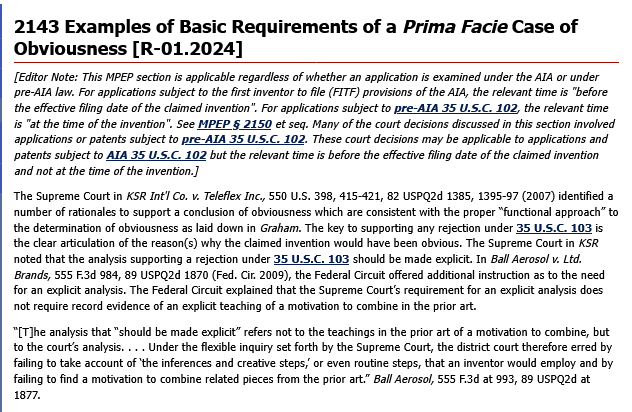
https://www.uspto.gov/web/offices/pac/mpep/s2143.html
This document is a section from the **Manual of Patent Examining Procedure (MPEP)** , specifically **Section 2143**. The MPEP is the handbook used by patent examiners and attorneys in the United States to guide the examination of patent applications.
In simple terms, this section provides a detailed, practical guide on how to determine if an invention is **”obvious”** and therefore not eligible for a patent. The core legal principle is found in 35 U.S.C. § 103, which states that a patent cannot be obtained if the differences between the claimed invention and the prior art (existing knowledge) are such that the invention as a whole would have been obvious to a person having ordinary skill in the art at the time the invention was made.
The central message of this entire chapter is that to reject a patent application for obviousness, an examiner cannot just say “it’s obvious.” They must provide a clear, articulated reasoning with factual findings that link the prior art to the claimed invention. This document explains this requirement in depth, providing specific examples of acceptable rationales.
Here is a detailed explanation of the key concepts, broken down for clarity.
---
### The Core Idea: A Prima Facie Case of Obviousness
The document begins by establishing what constitutes a *prima facie* (legally sufficient) case of obviousness. The Supreme Court case *KSR v. Teleflex* (2007) is the cornerstone of modern obviousness analysis. The key takeaways from this case, as highlighted in the text, are:
1. **Explicit Analysis is Required:** The reasoning behind an obviousness rejection must be made explicit. It’s not enough to just state a conclusion.
2. **Flexibility over Rigid Formulas:** The old, rigid test requiring an explicit “teaching, suggestion, or motivation” (TSM) to combine references is not the only path. The analysis must be flexible.
3. **Common Sense and Ordinary Ingenuity:** Examiners can rely on the common sense and ordinary creativity of a person skilled in the art, but this reliance must still be accompanied by a reasoned explanation. They cannot just say “it’s common sense” without support.
The document then lists and explains **seven specific rationales** that can be used to support a conclusion of obviousness. For each rationale, it provides a checklist of factual findings the examiner must make before using it, followed by real-world examples (primarily from court cases) to illustrate the principle.
---
### The Seven Rationales for Establishing Obviousness (with Examples)
Here is a breakdown of each rationale, the required findings, and the key lessons from the examples.
#### I.A. Combining Prior Art Elements to Yield Predictable Results
- **The Idea:** This is the most common rationale. It applies when a claimed invention is simply a new combination of old, known elements, and each element performs the same function in the new combination that it did in the old one. The result of the combination must have been **predictable** to a skilled person.
- **Required Findings:**
1. The prior art contained all the individual elements.
2. A skilled person could combine them using known methods.
3. The results of that combination would have been predictable.
- **Key Examples & Lessons:**
- **_Anderson’s-Black Rock v. Pavement Salvage_ (Obvious):** Putting a known radiant heater on a known paving machine was obvious. The heater did the same thing (heat) that it always did; the combination just put them together on one chassis for convenience. It yielded no new or unexpected function.
- **_United States v. Adams_ (Not Obvious):** Combining a magnesium electrode and a cuprous chloride electrode to make a new battery was **not** obvious. The prior art *taught away* from this combination, suggesting such batteries were impractical. The results were not predictable.
- **_Crocs, Inc. v. ITC_ (Not Obvious):** Adding a foam strap to a foam clog was not obvious. The prior art taught that foam was unsuitable for straps because it would stretch and deform. The combination did **not** yield predictable results; it actually created a new, beneficial friction fit that was not expected.
- **Key Lesson:** The fact that you *can* combine elements doesn’t make it obvious. You must show there was a **reason** to combine them and that the outcome was **predictable**. If the prior art teaches away from the combination, or if the combination yields surprising new results, the invention is likely not obvious.
#### I.B. Simple Substitution of One Known Element for Another
- **The Idea:** This is a subset of the first rationale. It applies when the claimed invention is achieved by simply swapping out one part of a known device for another known part, and the substitution predictably does the same job.
- **Required Findings:**
1. A prior art device had most of the claimed elements.
2. The substituted element and its function were known in the art.
3. The substitution could be made with predictable results.
- **Key Examples & Lessons:**
- **_Agrizap v. Woodstream_ (Obvious):** Replacing a mechanical pressure switch in a pest-control device with a well-known resistive electrical switch (like in a cattle prod) was obvious. The function of the resistive switch was known and predictable. The problem it solved (switch failure due to dirt) was the same in both devices.
- **_Aventis Pharma v. Lupin_ (Obvious in context of chemistry):** Purifying a specific active stereoisomer (5(S) ramipril) from a known mixture of stereoisomers was obvious. The prior art showed that purifying similar drugs to their active isomer dramatically improved efficacy, and separation techniques were known. The court warned against requiring an “explicit teaching” to purify this *specific* compound.
- **_Eisai Co. v. Dr. Reddy’s_ (Not Obvious in chemistry):** Modifying a known drug (lansoprazole) to create a new one (rabeprazole) was **not** obvious. The proposed modification would have replaced a known beneficial feature (a fluorinated group that increased lipophilicity) with a different group, which a skilled person would have expected to make the drug less effective.
- **Key Lesson:** Substitution is obvious if it’s a simple swap of one known part for another known part with a similar function. In chemistry, modifying a “lead compound” is obvious only if there’s a reason to make that specific change and a reasonable expectation that the new compound will have similar or better properties. If the change would destroy a known advantage, it’s not obvious.
#### I.C. Use of a Known Technique to Improve Similar Devices in the Same Way
- **The Idea:** If a technique has been used to successfully improve one device, and a person skilled in the art would recognize that the same technique could improve a similar device in the same predictable way, then using it is obvious.
- **Required Findings:**
1. A “base” device existed in the prior art.
2. A “comparable” device had been improved using a known technique.
3. A skilled person could apply that same technique to the base device with predictable results.
- **Key Example & Lesson:**
- **_In re Nilssen_ (Obvious):** A prior art device (the USSR certificate) had a circuit that could detect an overload but didn’t disable the device. Another prior art reference (Kammiller) taught a known technique: using a cutoff switch to disable an inverter during an overload to protect it. Applying that known protective technique to the first device to achieve the same predictable result (protection from overload) was obvious.
#### I.D. Applying a Known Technique to a Known Device Ready for Improvement
- **The Idea:** This is very similar to I.C. The focus here is on a known device that is a candidate for improvement, and a known technique that is ripe for application to it, with predictable results.
- **Required Findings:**
1. A “base” device existed in the prior art.
2. A known technique was available.
3. A skilled person would have recognized that applying the technique would yield predictable results and improve the device.
- **Key Example & Lesson:**
- **_Dann v. Johnston_ (Obvious):** The claimed invention was a computerized banking system that could track expenses by category. The “base” was the standard computerized banking system that tracked by account number. The “known technique” was the very concept of using account numbers (or similar codes) to sort and categorize data. Applying this fundamental technique to give customers a more detailed breakdown was an obvious and predictable use of a common data-processing tool.
#### I.E. “Obvious to Try”
- **The Idea:** This is perhaps the most nuanced rationale. It applies when there is a recognized problem and a **finite number of identified, predictable solutions**. If a person of ordinary skill would have had a good reason to try those known options and a reasonable expectation of success, the resulting invention is obvious. This is **not** about trying every option in an infinite field.
- **Required Findings:**
1. A recognized problem or need existed.
2. There was a finite number of identified, predictable potential solutions.
3. A skilled person could pursue these solutions with a reasonable expectation of success.
- **Key Examples & Lessons:**
- **_Pfizer v. Apotex_ (Obvious):** The drug amlodipine had manufacturing problems (”stickiness”). The problem was known. The finite set of predictable solutions was to test the 53 known “pharmaceutically acceptable salts” to find a better one. Trying this finite list was “obvious to try.”
- **_In re Kubin_ (Obvious in biotech):** A specific protein was known, and the goal was to isolate the gene that encodes it. The finite set of predictable solutions was the handful of standard molecular biology techniques (like those in the Sambrook manual) for doing just that. A person skilled in the art would have a reasonable expectation of success using these known methods.
- **_Takeda v. Alphapharm_ (Not Obvious):** The goal was to find a new diabetes drug. The prior art disclosed “hundreds of millions” of potential compounds. This is the opposite of a “finite number.” There was no guidance on where to start, and the closest prior art compound had known disadvantages that taught people away from it.
- **_Ortho-McNeil v. Mylan_ (Not Obvious):** A scientist accidentally discovered an anti-convulsant while working on an anti-diabetic drug. There was no finite set of options that would lead one to test an intermediate from a completely different drug development pathway for anti-convulsant properties.
- **Key Lesson:** “Obvious to try” works only when the options are few and the path is clear. It does not apply to exploring a vast, uncharted technological jungle. The outcome must be reasonably predictable, not just a shot in the dark.
#### I.F. Known Work in One Field Prompting Variations in Another Field
- **The Idea:** Design incentives or market forces can motivate a person skilled in the art to adapt a known device from one field for use in another, if the variations needed to do so are predictable.
- **Required Findings:**
1. A similar or analogous device existed in the prior art (possibly in a different field).
2. Design incentives or market forces would prompt its adaptation.
3. The differences between the claimed invention and the prior art were encompassed by known variations.
4. Implementing the variation would have been predictable.
- **Key Examples & Lessons:**
- **_Leapfrog v. Fisher-Price_ (Obvious):** Updating a mechanical children’s phonics toy (Bevan) with modern, well-understood electronics (like those in the Super Speak & Read device) was obvious. Market forces (desire for smaller, cheaper, more reliable toys) and the known technique of applying modern electronics to old mechanical devices made the combination obvious.
- **_KSR v. Teleflex_ (Obvious):** The invention was an adjustable gas pedal with an electronic sensor attached to a fixed part of the assembly. Market pressure to convert mechanical pedals to electronic ones was strong. The prior art taught where to put sensors to avoid wear (on a fixed part). Combining these well-known elements in a predictable way to meet a market need was obvious.
#### I.G. Explicit or Implicit Teaching, Suggestion, or Motivation (TSM)
- **The Idea:** This is the traditional rationale, which is still valid. It involves finding a reason to combine or modify references within the prior art itself. However, *KSR* made it clear that this motivation does not have to be an explicit statement. It can be **implicit** and can be found in the knowledge of a skilled person or the nature of the problem to be solved.
- **Required Findings:**
1. Some teaching, suggestion, or motivation (explicit or implicit) existed to modify or combine the references.
2. There was a reasonable expectation of success.
- **Key Lessons:**
- The motivation can come from the problem itself. If two references address the same problem, that can be motivation enough to combine them (as in the *Ruiz* foundation underpinning example).
- A prior art reference teaching multiple desirable alternatives does not “teach away” from the one the inventor chose.
- The proposed combination cannot change the “principle of operation” of a prior art device or render it unsatisfactory for its intended purpose. For example, you can’t simply turn a gravity-fed fuel filter upside down and expect it to work.
---
### Important Related Concepts
The document concludes with three subsections that are crucial for a complete understanding of obviousness rejections.
- **2143.01 (Motivation):** Reiterates the flexible nature of the motivation inquiry post-*KSR* and clarifies that a proposed modification cannot make a prior art device inoperable for its intended purpose or change its basic principle of operation.
- **2143.02 (Reasonable Expectation of Success):** Emphasizes that a reason to combine is not enough. There must also be a **reasonable expectation of success**. This doesn’t require absolute proof of success, but it does require more than mere hope, especially in unpredictable arts. It also clarifies that predictability is judged as of the time of the invention (or the effective filing date under AIA).
- **2143.03 (All Claim Limitations Must Be Considered):** A fundamental rule. Examiners cannot ignore parts of a claim. Every element in a claim must be accounted for in the obviousness analysis. If a claim is indefinite, it should be rejected on that ground as well, not just ignored.
### Conclusion
In essence, **MPEP 2143** is a masterclass on how to properly argue that an invention is obvious. It moves the analysis away from a rigid, mechanical checklist to a more holistic and flexible inquiry guided by the principles of *KSR*. The central theme is that an obviousness rejection must be a well-reasoned legal argument built on a foundation of factual findings, not a mere conclusion. The examiner must articulate *why* a person of ordinary skill, armed with common sense and facing market pressures, would have been motivated to combine or modify prior art teachings in a specific, predictable way to arrive at the claimed invention with a reasonable expectation of success.
## Peer Review of MPEP § 2143: “Examples of Basic Requirements of a Prima Facie Case of Obviousness”
### Overview
This MPEP section serves as the primary guidance document for USPTO examiners on formulating obviousness rejections under 35 U.S.C. § 103 following the Supreme Court’s decision in *KSR International Co. v. Teleflex Inc.* (2007). The section aims to translate the Court’s “flexible approach” to obviousness into actionable examination guidelines, providing seven enumerated rationales supported by extensive case law examples.
### Strengths
**1. Comprehensive Coverage of KSR Rationales** – The section effectively organizes the post-KSR obviousness analysis into seven distinct, well-articulated rationales (A through G). This structure provides examiners with a clear toolkit for approaching different factual scenarios, from simple element combinations to “obvious to try” situations.
**2. Robust Use of Illustrative Examples** – Each rationale is accompanied by multiple detailed examples drawn from Federal Circuit and Supreme Court precedent. The inclusion of both pre- and post-KSR cases, with explanations of how each illustrates the particular rationale, is pedagogically sound. Particularly valuable are the counter-examples showing when rationales *cannot* be applied (e.g., *Adams*, *Omeprazole*, *Crocs*).
**3. Emphasis on Explicit Analysis** – The section consistently reinforces that obviousness rejections require “clear articulation” and “reasoned explanation,” not mere conclusory statements. The repeated citation to *KSR*’s endorsement of the *Kahn* standard (”articulated reasoning with some rational underpinning”) appropriately elevates the quality of analysis expected.
**4. Practical Procedural Guidance** – Subsections 2143.01-.03 address critical ancillary issues: motivation to modify, reasonable expectation of success, and consideration of all claim limitations. This tripartite structure mirrors the analytical framework examiners should apply.
**5. Currency and Cross-Referencing** – The January 2024 revision date and extensive cross-references to other MPEP sections (e.g., § 2141 on Graham factors, § 2150 on AIA applicability) demonstrate careful updating and integration with the broader manual.
### Areas for Improvement
**1. Excessive Length and Density** – At approximately 9,000+ words, this section presents significant readability challenges. Examiners seeking quick guidance may struggle to locate specific answers. Consider:
- Adding a concise executive summary or quick-reference table
- Using more frequent subheadings within the lengthy examples
- Placing the most recent or most frequently cited examples (e.g., *KSR*, *Kubin*, *Van Os*) more prominently
**2. Redundancy Across Examples** – Several examples appear in multiple subsections (e.g., *Ruiz v. A.B. Chance Co.* appears in I.A., I.B., and I.C.). While cross-illustration has pedagogical value, the verbatim repetition consumes substantial space. Consider:
- Using cross-references (”see Example 2 in subsection I.A.”)
- Including only the novel analytical point in secondary appearances
**3. AIA Transition Complexity** – The repeated “Editor Notes” explaining applicability under both AIA and pre-AIA law, while necessary, create narrative disruption. The current approach places these notes at the beginning of § 2143 and each subsection. Consider consolidating this guidance into a single, prominent explanation at the section’s outset with a simple symbol system (e.g., [AIA] and [pre-AIA] margin notations) for case applicability.
**4. Lead Compound Discussion Placement** – The extensive discussion of lead compounds (spanning *Eisai*, *Procter & Gamble*, *Altana*, and *Takeda*) appears under “Simple Substitution” (I.B.). While this is not incorrect, the lead compound analysis has evolved into a distinct doctrinal area that may warrant separate treatment. Consider creating a dedicated subsection addressing chemical obviousness and lead compound methodology.
**5. “Common Sense” Guidance** – The section appropriately addresses common sense in *Perfect Web* and *Wyers* but could more explicitly guide examiners on *when* and *how* to invoke common sense without crossing into impermissible speculation. The *Arendi v. Apple* citation (requiring “reasoned analysis and evidentiary support”) is included but buried. This point deserves greater emphasis.
**6. Obvious-to-Try Nuance** – The subsection on “Obvious To Try” (I.E.) includes excellent examples but could better synthesize the *O’Farrell* framework distinguishing proper from improper applications. Consider adding a comparative table contrasting the *Kubin*/*Bayer* fact patterns (proper) with *Takeda*/*Ortho-McNeil* (improper) to crystallize the distinction.
### Specific Observations
| Element | Assessment | Recommendation |
|---------|------------|----------------|
| **Introductory Note on AIA** | Disruptive placement | Move to a footnote or section-specific preface |
| **Example 3 (Omeprazole)** | Excellent teaching on unknown problems | Keep prominent |
| **Example 6 (Ecolab)** | Strong on optimization within ordinary skill | Consider adding to “Obvious to Try” section |
| **ICON Health & Fitness** | Valuable on analogous art | Could cross-reference § 2141.01(a) |
| **Section 2143.01** | Well-structured on motivation | Add more post-*KSR* examples |
### Technical Accuracy
The section demonstrates meticulous attention to legal accuracy. Citations are current through 2023 (*Axonics*, *Elekta*, *Intel v. PACT XPP*). The treatment of *In re Deuel*’s partial abrogation by *Kubin* is appropriately nuanced. The discussion of the “finite number” requirement in obvious-to-try cases correctly distinguishes *Takeda* (hundreds of millions of compounds = not finite) from *Pfizer* (53 salts = finite).
### Recommendations for Revision
1. **Structural Optimization**: Create a quick-reference guide with:
- The seven rationales in summary form
- Key questions examiners must answer for each rationale
- “Red flags” indicating when a rationale cannot apply
2. **Content Consolidation**: Reduce redundancy by:
- Using cross-references for repeated examples
- Creating an appendix with full case summaries
- Moving extended lead compound discussion to § 2144.09
3. **Readability Enhancements**:
- Add bulleted “essential findings” boxes for each rationale
- Include decision trees for complex analyses (e.g., obvious-to-try)
- Use typographical emphasis for key doctrinal statements
4. **Clarity on Burden Shifting**:
- More explicitly distinguish examiner’s prima facie burden from applicant’s rebuttal
- Add guidance on weighing secondary considerations evidence
### Conclusion
This MPEP section is a comprehensive, legally sound, and practically useful guide to obviousness analysis. Its strengths—thorough case coverage, doctrinal accuracy, and emphasis on reasoned analysis—substantially outweigh its organizational weaknesses. The primary opportunities for improvement lie in accessibility and conciseness rather than substantive content. With targeted revisions to reduce redundancy and enhance navigability, this section will continue to serve as an authoritative resource for examiners navigating the post-*KSR* obviousness landscape.
**Overall Assessment**: Meets its objectives with distinction; recommended revisions are enhancements rather than corrections.
Supreme Court Cases
Anderson’s-Black Rock, Inc. v. Pavement Salvage Co., 396 U.S. 57 (1969).
Graham v. John Deere Co. of Kansas City, 383 U.S. 1 (1966).
Great Atlantic & Pacific Tea Co. v. Supermarket Equipment Corp., 340 U.S. 147 (1950).
KSR International Co. v. Teleflex Inc., 550 U.S. 398 (2007).
Sakraida v. AG Pro, Inc., 425 U.S. 273 (1976).
United States v. Adams, 383 U.S. 39 (1966).
Federal Circuit Cases
Abbott Labs. v. Sandoz, Inc., 544 F.3d 1341 (Fed. Cir. 2008).
Acorda Therapeutics, Inc. v. Roxane Lab., Inc., 903 F.3d 1310 (Fed. Cir. 2018).
Agrizap, Inc. v. Woodstream Corp., 520 F.3d 1337 (Fed. Cir. 2008).
Allied Erecting v. Genesis Attachments, 825 F.3d 1373 (Fed. Cir. 2016).
Altana Pharma AG v. Teva Pharm. USA, Inc., 566 F.3d 999 (Fed. Cir. 2009).
Alza Corp. v. Mylan Labs., Inc., 464 F.3d 1286 (Fed. Cir. 2006).
Amgen, Inc. v. Chugai Pharm. Co., 927 F.2d 1200 (Fed. Cir. 1991).
Arendi S.A.R.L. v. Apple Inc., 832 F.3d 1355 (Fed. Cir. 2016).
Aventis Pharma Deutschland v. Lupin Ltd., 499 F.3d 1293 (Fed. Cir. 2007).
Axonics, Inc. v. Medtronic, Inc., 73 F.4th 950 (Fed. Cir. 2023).
B/E Aerospace, Inc. v. C&D Zodiac, Inc., 962 F.3d 1373 (Fed. Cir. 2020).
Ball Aerosol v. Ltd. Brands, 555 F.3d 984 (Fed. Cir. 2009).
Bayer Schering Pharma A.G. v. Barr Labs., Inc., 575 F.3d 1341 (Fed. Cir. 2009).
Crocs, Inc. v. U.S. Int’l Trade Comm’n, 598 F.3d 1294 (Fed. Cir. 2010).
Dann v. Johnston, 425 U.S. 219 (1976).
DePuy Spine, Inc. v. Medtronic Sofamor Danek, Inc., 567 F.3d 1314 (Fed. Cir. 2009).
DyStar Textilfarben GmbH & Co. Deutschland KG v. C.H. Patrick Co., 464 F.3d 1356 (Fed. Cir. 2006).
Ecolab, Inc. v. FMC Corp., 569 F.3d 1335 (Fed. Cir. 2009).
Eisai Co. Ltd. v. Dr. Reddy’s Labs., Ltd., 533 F.3d 1353 (Fed. Cir. 2008).
Elekta Ltd. v. ZAP Surgical Sys., Inc., 81 F.4th 1368 (Fed. Cir. 2023).
Eli Lilly & Co. v. Teva Pharms. Int’l GmbH, 8 F.4th 1331 (Fed. Cir. 2021).
Fresenius USA, Inc. v. Baxter Int’l, Inc., 582 F.3d 1288 (Fed. Cir. 2009).
Griffin v. Bertina, 285 F.3d 1029 (Fed. Cir. 2002).
Hoffmann-La Roche Inc. v. Apotex Inc., 748 F.3d 1326 (Fed. Cir. 2014).
In re Dance, 160 F.3d 1339 (Fed. Cir. 1998).
In re Deuel, 51 F.3d 1552 (Fed. Cir. 1995).
In re Fine, 837 F.2d 1071 (Fed. Cir. 1988).
In re Fout, 675 F.2d 297 (CCPA 1982).
In re Fulton, 391 F.3d 1195 (Fed. Cir. 2004).
In re Gordon, 733 F.2d 900 (Fed. Cir. 1984).
In re Gulack, 703 F.2d 1381 (Fed. Cir. 1983).
In re ICON Health & Fitness, Inc., 496 F.3d 1374 (Fed. Cir. 2007).
In re Kahn, 441 F.3d 977 (Fed. Cir. 2006).
In re Kubin, 561 F.3d 1351 (Fed. Cir. 2009).
In re Lee, 277 F.3d 1338 (Fed. Cir. 2002).
In re Merck & Co., Inc., 800 F.2d 1091 (Fed. Cir. 1986).
In re Miller, 441 F.2d 689 (CCPA 1971).
In re Nilssen, 851 F.2d 1401 (Fed. Cir. 1988).
In re O’Farrell, 853 F.2d 894 (Fed. Cir. 1988).
In re Omeprazole Patent Litigation, 536 F.3d 1361 (Fed. Cir. 2008).
In re Ratti, 270 F.2d 810 (CCPA 1959).
In re Rinehart, 531 F.2d 1048 (CCPA 1976).
In re Steele, 305 F.2d 859 (CCPA 1962).
In re Urbanski, 809 F.3d 1237 (Fed. Cir. 2016).
In re Van Os, 844 F.3d 1359 (Fed. Cir. 2017).
In re Wilson, 424 F.2d 1382 (CCPA 1970).
In re Young, 927 F.2d 588 (Fed. Cir. 1991).
In re Zurko, 258 F.3d 1379 (Fed. Cir. 2001).
Intel Corp. v. PACT XPP Schweiz AG, 61 F.4th 1373 (Fed. Cir. 2023).
Intelligent Bio-Sys., Inc. v. Illumina Cambridge Ltd., 821 F.3d 1359 (Fed. Cir. 2016).
Leapfrog Enters., Inc. v. Fisher-Price, Inc., 485 F.3d 1157 (Fed. Cir. 2007).
Medichem, S.A. v. Rolabo, S.L., 437 F.3d 1157 (Fed. Cir. 2006).
Muniauction, Inc. v. Thomson Corp., 532 F.3d 1318 (Fed. Cir. 2008).
Ortho-McNeil Pharm., Inc. v. Mylan Labs, Inc., 520 F.3d 1358 (Fed. Cir. 2008).
OSI Pharm., LLC v. Apotex Inc., 939 F.3d 1375 (Fed. Cir. 2019).
Perfect Web Techs., Inc. v. InfoUSA, Inc., 587 F.3d 1324 (Fed. Cir. 2009).
Pfizer, Inc. v. Apotex, Inc., 480 F.3d 1348 (Fed. Cir. 2007).
PharmaStem Therapeutics, Inc. v. ViaCell, Inc., 491 F.3d 1342 (Fed. Cir. 2007).
Plantronics, Inc. v. Aliph, Inc., 724 F.3d 1343 (Fed. Cir. 2013).
Procter & Gamble Co. v. Teva Pharm. USA, Inc., 566 F.3d 989 (Fed. Cir. 2009).
Rolls-Royce, PLC v. United Tech. Corp., 603 F.3d 1325 (Fed. Cir. 2010).
Ruiz v. A.B. Chance Co., 357 F.3d 1270 (Fed. Cir. 2004).
Sanofi-Synthelabo v. Apotex, Inc., 550 F.3d 1075 (Fed. Cir. 2008).
Sundance, Inc. v. DeMonte Fabricating Ltd., 550 F.3d 1356 (Fed. Cir. 2008).
Takeda Chem. Indus., Ltd. v. Alphapharm Pty., Ltd., 492 F.3d 1350 (Fed. Cir. 2007).
Wyers v. Master Lock Co., 616 F.3d 1231 (Fed. Cir. 2010).
Zup v. Nash Mfg., 896 F.3d 1365 (Fed. Cir. 2018).
Administrative Decisions (Board of Patent Appeals and Interferences)
Ex parte Blanc, 13 USPQ2d 1383 (Bd. Pat. App. & Inter. 1989).
Ex parte Catan, 83 USPQ2d 1569 (Bd. Pat. App. & Int. 2007).
Ex parte Erlich, 3 USPQ2d 1011 (Bd. Pat. App. & Inter. 1986).
Ex parte Grasselli, 231 USPQ 393 (Bd. App. 1983), aff’d mem., 738 F.2d 453 (Fed. Cir. 1984).
Ex parte Ionescu, 222 USPQ 537 (Bd. Pat. App. & Inter. 1984).
Ex parte Levengood, 28 USPQ2d 1300 (Bd. Pat. App. & Inter. 1993).
Ex parte Smith, 83 USPQ2d 1509 (Bd. Pat. App. & Int. 2007).
Statutory and Regulatory Materials
35 U.S.C. § 101.
35 U.S.C. § 103 (pre-AIA and AIA).
35 U.S.C. § 112.
37 C.F.R. § 1.130.
Administrative Guidance
U.S. Patent and Trademark Office, Manual of Patent Examining Procedure (MPEP) (9th ed. Rev. Jan. 2024).
MPEP § 2141.
MPEP § 2143.
MPEP § 2144.05.
MPEP § 2150 et seq.
MPEP § 2175.
MPEP § 2181.